All Speed Limits in Aviation
While studying for my commercial pilot license on Gleim, a speed limit question came up. That was the perfect opportunity to procrastinate and write a blog post about all the speed limits in aviation. Here you go!
This post aims to be comprehensive and cover (almost) every speed limit that exists in US aviation. I divide them into: regulatory limits from the FARs, procedure-specific limits from plates, aircraft-specific limitations, ATC-assigned restrictions, and soft limits.
Regulatory Speed Limits (14 CFR Part 91)
The upper bound: Mach 1
No person may operate a civil aircraft at speeds exceeding Mach 1 within US airspace (§91.817). This regulation was established in 1973. It may be subject to change following a June 2025 executive order directing the FAA to repeal the overland supersonic flight prohibition and establish noise-based certification standards instead.
Below 10,000 feet MSL
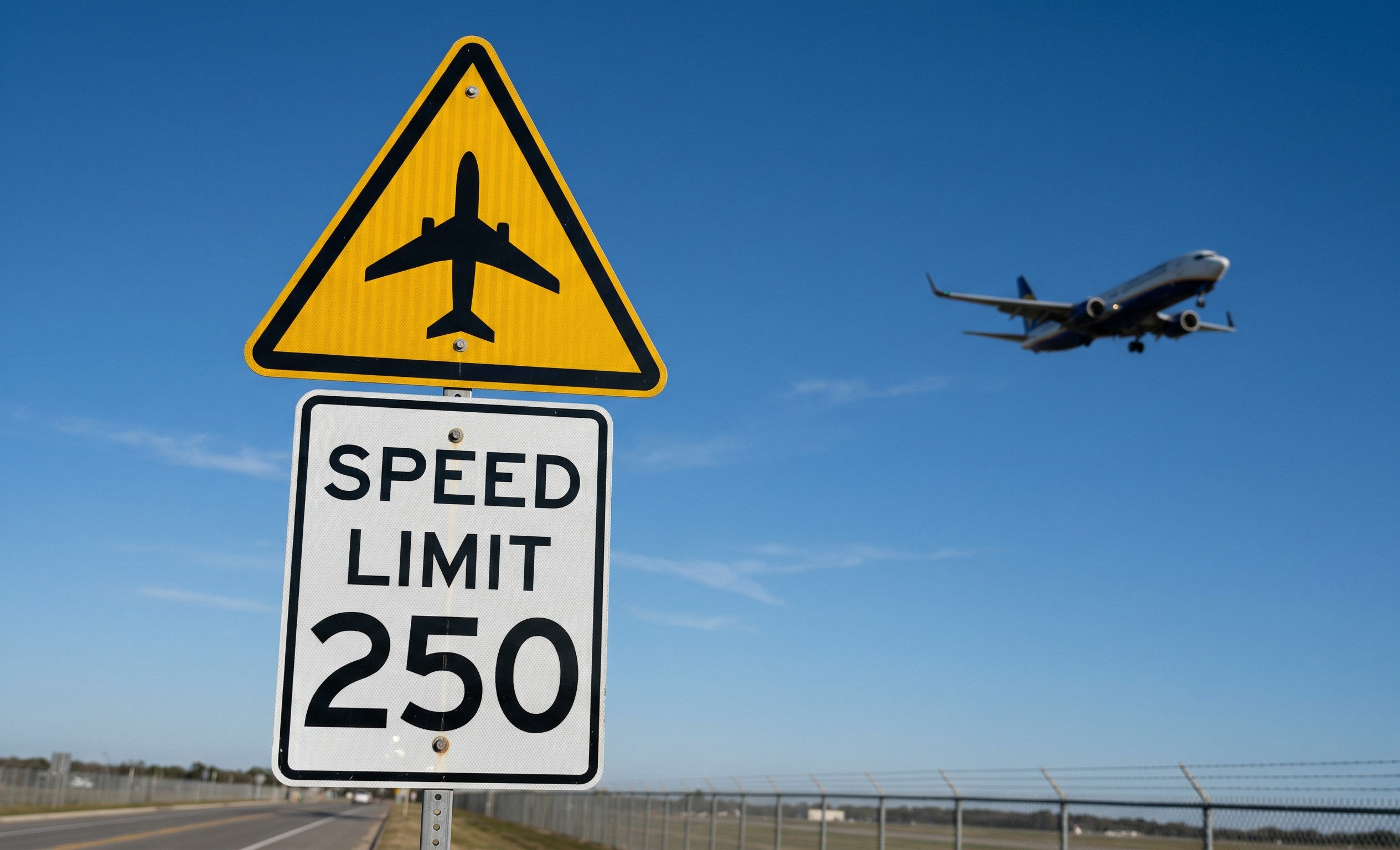
250 knots indicated airspeed is the maximum unless otherwise authorized by ATC (§91.117(a)). It applies to all aircraft below 10,000 feet MSL in US airspace, whether you’re in Class A, B, C, D, E, or G airspace.
200 knots near airports
200 knots indicated applies in two situations (§91.117(b-c)):
- Below Class B airspace or in a VFR corridor through it
- Within 4 nautical miles of the primary airport of Class C or D airspace, at or below 2,500 feet AGL
Once inside Class B airspace, the 200-knot restriction no longer applies.
Procedure-Specific Speed Limits
Approach plates
Instrument approach procedures may include speed restrictions at specific fixes.


RNAV 06 at KMJX with speed restriction highlighted (an approach I flew on my instrument checkride :)).
SIDs and STARs
Standard Instrument Departures (SIDs) and Standard Terminal Arrival Routes (STARs) often include multiple speed restrictions at various waypoints.


AALLE FOUR arrival into KDEN with ellipses highlighting speed restrictions.
Procedure turns and holding patterns
When flying a procedure turn, the speed limit is 200 knots IAS maximum unless a higher speed is specifically published (AIM 5-4-9(a)(3)).
Holding patterns have altitude-dependent speed limits (AIM 5-3-8(j)(2)(a)):
- Up to 6,000 feet MSL: 200 KIAS maximum
- 6,001 to 14,000 feet MSL: 230 KIAS maximum
- Above 14,000 feet MSL: 265 KIAS maximum
At military airfields, different holding speeds apply: USAF airfields 310 KIAS, Navy airfields 230 KIAS (AIM 5-3-8(j)(2)(b)(3-4)).
Helicopters and power lift aircraft hold with a minimum of 90 KIAS unless charted otherwise (AIM 5-3-8(j)(2)(b)(5)).
Aircraft-Specific Limitations
Every aircraft has its own set of speed limitations based on its design and certification. These are found in the Pilot’s Operating Handbook (POH) or Airplane Flight Manual (AFM).
- VNO – Maximum structural cruising speed (top of the green arc)
- VNE – Never exceed speed (red line)
- VFE – Maximum flap extended speed (top of the white arc)
- VLE – Maximum landing gear extended speed
- VLO – Maximum landing gear operating speed
- VA – Maneuvering speed
- Turbulence penetration speed
ATC-Assigned Speed Restrictions
ATC can assign specific speeds for traffic sequencing and separation. Common instructions:
- “Maintain 180 knots”
- “Maintain best forward speed”
- “Reduce to final approach speed” or “Maintain 160 to the marker”
- “Resume normal speed”
Soft Limits
Minimum safe airspeed exception
Safety takes precedence over speed limits (§91.3). If an operation requires a speed above the regulatory maximum, the aircraft may operate at that speed (§91.117(d)).
Careless or reckless operation as a soft limit
While §91.13 doesn’t specify a speed, it prohibits careless or reckless operation that endangers life or property. Flying at speeds that are technically legal but inappropriate for conditions (weather, traffic, terrain) can still violate this regulation. It acts as a soft upper bound beyond the explicit limits.